boberdoo is one of the oldest dedicated lead distribution systems on the market. It handles lead capture, ping-post and direct-post delivery, buyer and vendor management, and reporting for lead generation companies.
Its strength is configurability: almost every part of the routing logic can be tailored. The trade-off is that many changes go through the vendor, and the interface reflects its age.
Why teams look for a boberdoo alternative
Changes wait on support tickets
boberdoo is highly configurable, but many routing and buyer changes are made by the vendor rather than by your team. When a buyer changes caps or filters mid-day, waiting on a ticket costs leads.
The interface shows its age
Onboarding new operators and buyers takes longer on a legacy interface, and daily tasks such as adjusting caps or checking a buyer's acceptance rate take more clicks than they should.
Profit is hard to see per source
Teams that buy traffic from several sources want cost per lead next to revenue for every source and campaign, after returns. Assembling that view outside the platform is manual work.
Rejected leads need a plan
A post that is rejected by the winning buyer should be offered to the next bidder automatically. Teams tell us this is where they lose margin when fallback is not fully automated.
When boberdoo is still the right choice
Switching platforms costs time, so be honest about whether the reasons above apply to you. boberdoo remains a sensible option if:
You have an unusual routing model that needs deep customization and you are happy to work through the vendor for changes.
Your operations team is already fluent in boberdoo and your buyer network is stable.
You depend on a boberdoo-specific integration that a partner has built and maintains.
Our top pick: Vertikl
Vertikl is a lead distribution platform that connects sources, validation, routing and buyers in one place. It runs ping-post, direct-post and ring-tree delivery, retries and falls back automatically when a buyer rejects, and reconciles cost per lead from every source with revenue per buyer.
It is aimed at lead sellers, brokers and pay-per-lead agencies first, with a second use case for lead buyers and brands that want validated, deduplicated leads delivered into their CRM. Onboarding includes migration and support, with a 14-day free trial.
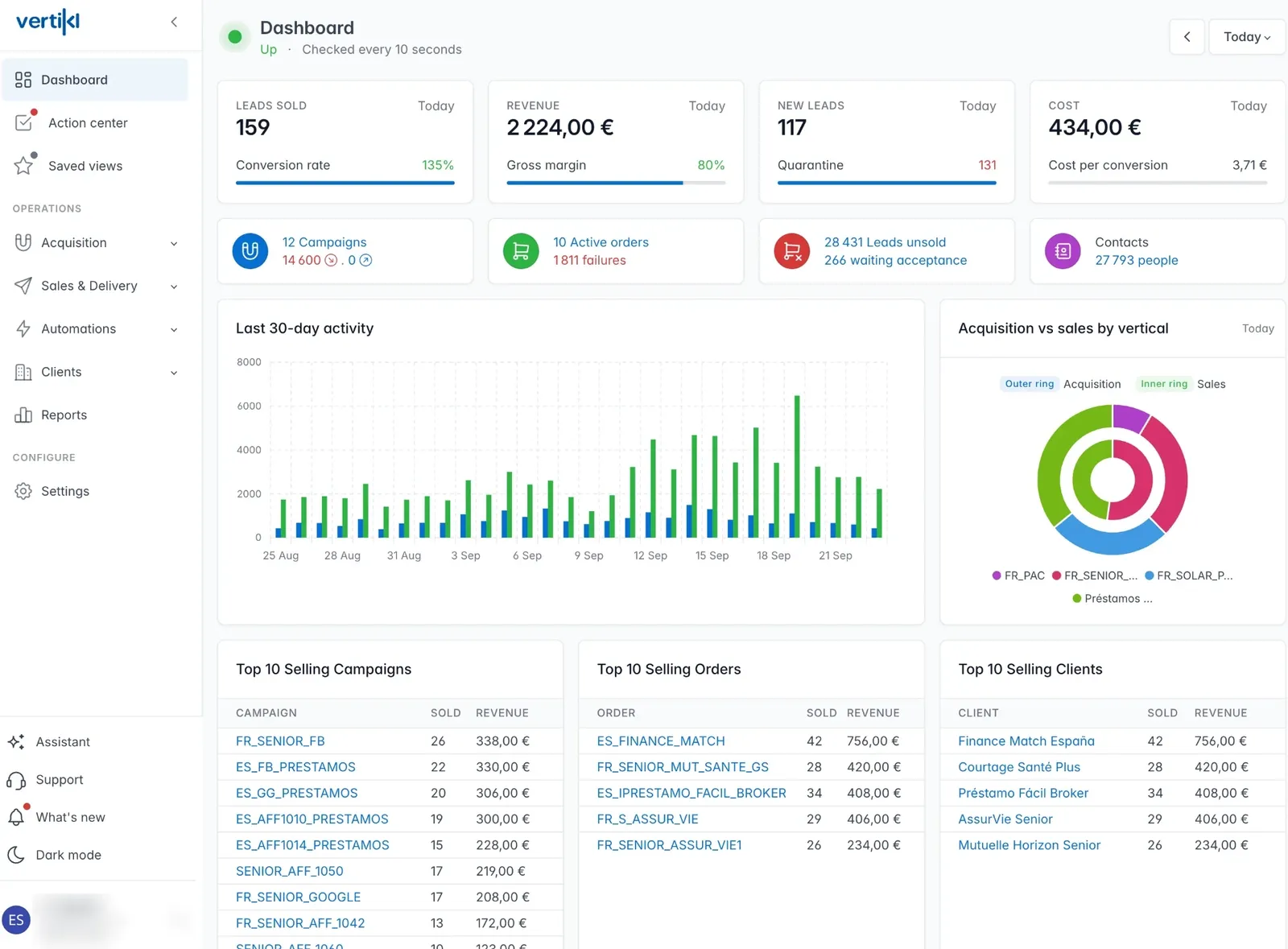
The Vertikl dashboard: leads sold, revenue, gross margin and cost per conversion for the day, with unsold leads and leads waiting acceptance one click away. Demo data.
Compared with boberdoo, the biggest differences teams notice are these:
Self-serve changes
Caps, filters, schedules, prices and buyer priorities are edited by your team in the interface and applied instantly, without a support ticket.
Profit per source out of the box
True cost per lead is synced from each source and shown next to revenue by buyer and campaign, so unprofitable sources are visible the same day.
Automatic recovery of rejected leads
Retries, fallback buyers and ring trees are part of every campaign, so a rejected post is resold instead of written off.
Migration and trial included
A 14-day free trial with migration and support included lowers the cost of testing the switch.
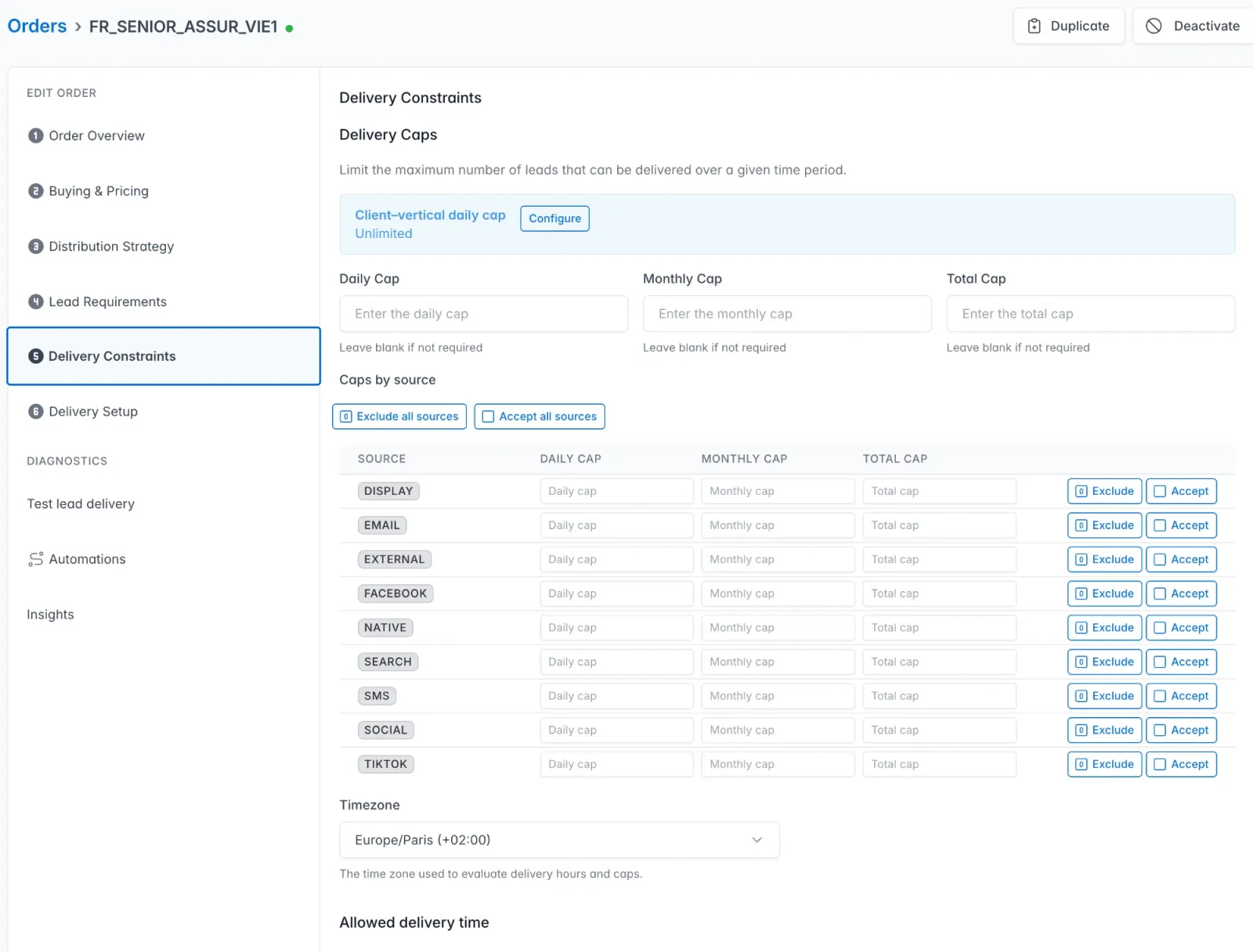
Delivery constraints on a buyer order: daily, monthly and total caps, caps per source, time zone and delivery hours, edited by your team and applied immediately. Demo data.
"Ask vendor" means we could not confirm the capability from boberdoo's public material. Confirm it with their team before deciding.
All boberdoo alternatives reviewed
Ranked on routing power, recovery of rejected leads, profit visibility, lead quality controls and ease of operations. See how we review.
#1
Our top pick
Best for: Lead sellers, brokers and agencies that want to maximize revenue per lead
Modern, all-in-one platform that connects lead sources, validation, routing logic and buyers. Built around profit per lead: real-time auctions, automatic fallback when a buyer rejects, and true cost per lead synced from every source.
Strengths
Ping-post, direct-post and ring-tree delivery
Automatic retries and fallback buyers to recover unsold leads
Source-level profit and CPL tracking in one dashboard
Caps, filters, schedules, validation and billing automated
Delivery via ping-post, webhooks, sheets, email, SMS and custom APIs
Isolated infrastructure, full import/export, bidirectional API, GDPR compliant
14-day free trial, migration and support included
Watch outs
Newer brand than the legacy players in the category
No call tracking or email marketing modules: it is focused on lead distribution
Best for: UK and European lead generators focused on data quality and compliance
UK-based lead management platform that validates, deduplicates and distributes leads in real time, with a strong focus on data quality and GDPR compliance.
A platform switch is mostly an inventory and a parallel run. Here is the order that works for teams leaving boberdoo.
Export your buyer and vendor lists. Pull every buyer with its filters, caps, prices and schedules, and every vendor or source with its posting specs. This is the inventory the migration is built from.
Map posting specs. Each source currently posting to boberdoo needs a new endpoint. Vertikl's onboarding team maps fields and sends new specs to your sources; run both endpoints in parallel for a few days.
Rebuild routing as campaigns. Group buyers by vertical and format (exclusive, shared, ping-post) and set priorities, caps and fallbacks per campaign.
Move buyers one at a time. Start with the highest-volume buyer, confirm acceptance rate and returns match, then move the rest.
Reconcile the first invoice cycle. Compare buyer invoices and source costs from both systems for one billing period before switching off the old one.
Not sure what better routing is worth for your volume? The lead profit calculator estimates the margin recovered from unsold leads.
Frequently asked questions
Which boberdoo alternative is easiest to migrate to?
Choose a vendor that includes migration in onboarding. Vertikl maps your sources, buyers and rules during the 14-day trial so you can run both systems in parallel before switching.
Do boberdoo alternatives support ping-post?
All the platforms in this comparison support ping-post. The differences are in fallback automation, profit reporting and how much of the setup your team can do without vendor help.
Can I keep my buyers' existing posting specs?
Buyers keep their own inbound specs. What changes is the endpoint your sources post to. Your new platform maps fields to each buyer's spec, so buyers rarely need to change anything.