
Home / What is lead distribution
What Is Lead Distribution?
Lead distribution is the process of sending each incoming lead to the buyer, client or sales rep most likely to convert it, as fast as possible, under rules you control.

Every business that generates leads has to decide who gets each one. For an internal sales team that means which rep. For a lead seller or agency it means which buyer, at what price, and what happens if that buyer says no. Lead distribution is the set of rules and automation that makes that decision in seconds, records it, and turns it into revenue. This guide explains the models, the rules behind them, and the point at which spreadsheets and CRM assignment stop being enough.
Lead distribution models
| Model | How it works | Typical use |
|---|---|---|
| Round robin | Leads rotate evenly between recipients | Internal sales teams |
| Weighted | Each recipient gets a share (for example 50/30/20) | Buyers with different volumes or contracts |
| Priority / waterfall | Top recipient first, then the next if capped or rejected | Preferred buyers and fallbacks |
| Geographic | Routed by state, zip code or country | Local services, licensed verticals |
| Skill or product based | Routed by product, language or lead attributes | Multi-product teams, call centers |
| Auction (ping-post) | Buyers bid in real time, highest bid wins | Lead sellers and marketplaces |
Round robin and weighted
Round robin is the simplest model: leads go to recipients in turn. It is fair and easy to explain, which is why CRMs default to it for internal teams. Weighted distribution is round robin with proportions, so a buyer who committed to 50% of your volume gets that share. Both models ignore lead value; every lead is treated the same regardless of what a buyer would pay.
Priority and waterfall
In a priority model, the lead goes to the top recipient first and moves down the list only if that recipient is capped, closed or rejects. It is the right model when one buyer pays a premium for first look, or when you want a fixed-price buyer to see leads before secondary buyers. The list is often called a waterfall or, when used as a fallback after an auction, a ring tree.
Geographic and skill based
Many verticals cannot route without geography: insurance agents need a license in the consumer's state, installers cover a territory, law firms practice in specific jurisdictions. Skill based routing adds product, language or lead attributes to the decision, so a Spanish speaking lead reaches a Spanish speaking rep and a commercial insurance lead reaches a commercial specialist.
Auction
In an auction model, eligible buyers bid on each lead and the highest acceptable bid wins. This is ping-post, the standard for lead sellers with several buyers. It is the only model that prices each lead at its market value, and it combines with a priority list for fallback.
The rules behind every routing decision
Whatever the model, the platform applies the same categories of rules before a lead moves.
- Filters: state, zip, age, credit, product, property type, any field a buyer uses to decide what they want.
- Caps: hourly, daily, weekly or monthly limits per buyer, and budget limits.
- Schedules: business hours and days when a buyer accepts leads, in their time zone.
- Pricing: fixed price, bid, floor price, or price by segment.
- Exclusivity: exclusive leads sold once, or shared leads sold to several non competing buyers.
- Validation: phone and email checks, deduplication windows and suppression lists applied before delivery.
- Returns: rules for rejected or returned leads, credits, and whether the lead can be resold.
A worked example
A solar lead seller receives a lead from a Meta campaign: a homeowner in Arizona with a monthly electricity bill above 200 dollars. The platform validates the phone number and checks that the same number has not been received in the last 30 days. Three installers are eligible: two cover Arizona and are within their daily caps, the third is closed on weekends. The two eligible installers are pinged; one bids 45 dollars, the other 38. The lead is posted to the first, who rejects it because the address is already in their CRM. Fallback posts it to the second installer, who accepts at 38 dollars. Cost per lead from the Meta campaign is synced at 22 dollars, so the platform records a 16 dollar margin for that source. The whole sequence takes a few seconds and nobody touched it.
Now imagine the same lead without automation: a form notification by email, a spreadsheet of buyer caps, a manual forward to the first installer, a rejection reply the next morning, and no record of what the Meta campaign cost per lead. That is the gap lead distribution software closes.
Lead routing vs lead distribution
CRM tools use "lead routing" for assigning inbound leads to internal reps. Lead distribution goes further: it includes selling leads to external buyers, pricing, caps, delivery to other systems, returns and billing. If you sell or buy leads at volume, you need a dedicated platform rather than CRM assignment rules. If you only assign leads to your own team, a CRM may be enough, until you start buying leads from several sources and need to know which source is profitable.
Who needs lead distribution
Lead sellers and agencies
Sell each lead to the best buyer, recover rejected leads, track profit by source and bill buyers automatically.
Lead buyers and brands
Filter, validate and deduplicate incoming leads, then dispatch to the right team or CRM with caps by source.
Sales teams with several sources
Assign by territory or skill, respond in seconds, and see which source produces leads that close.
When to move to dedicated software
- You manage caps and filters in spreadsheets, or in a buyer's head.
- Rejected leads are not resold, or are resold by email the next day.
- You cannot tell which traffic source is profitable after buyer returns.
- Billing buyers takes days every month.
- Adding a buyer or a source means a developer ticket.
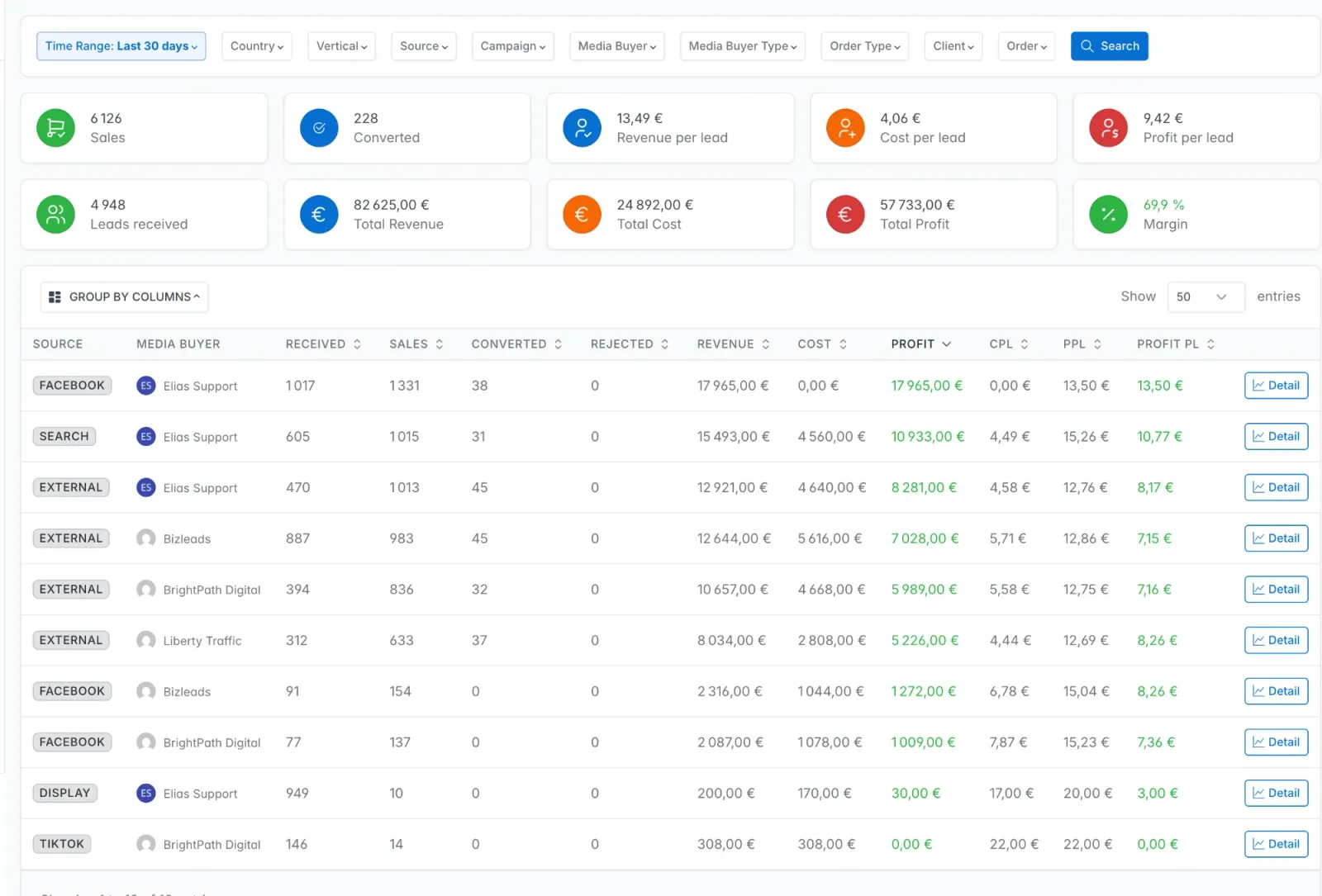
Two or more of these usually mean the cost of the platform is smaller than the margin you are losing. The lead profit calculator gives a rough number, and our ranking compares the platforms. The report below is what "profit per source" means in practice: revenue, cost and margin per source and media buyer, on one screen.
Lead distribution by industry
Filters, caps and compliance rules differ by vertical. See our guides for insurance, solar, home services, mortgage and finance and legal leads.
Frequently asked questions
What are the main lead distribution methods?
Round robin, weighted distribution, priority (waterfall), geographic or territory routing, skill based routing, and auction based models such as ping-post.
Why automate lead distribution?
Lead value drops fast. Automation delivers leads in seconds, applies caps and filters consistently, recovers rejected leads, and gives you reliable profit data.
Is lead distribution the same as lead routing?
Lead routing usually means assigning inbound leads to internal sales reps. Lead distribution is broader: it includes selling leads to external buyers, with pricing, caps, delivery, returns and billing.
Can a CRM do lead distribution?
CRMs handle round robin and territory assignment for internal teams well. They do not run auctions, bill external buyers, apply per-buyer caps or track profit per source, which is what a dedicated platform adds.
How fast should a lead be distributed?
Seconds. Contact rates fall sharply within minutes of a form fill, and buyers price leads on freshness. Any manual step in the path adds delay.